
An AI Approach: Four Ways In, and How to Know Which One Fits
A common question from business owners is this:
"We know AI is important. But where do we start?"
It's a fair question.
Every week there's another AI tool, another news story, or another company saying they're using AI. It's easy to feel like you're falling behind.
But they are understandably falling into the trap of being seduced by impressive use cases and claims.
The better question is:
"What problem are we trying to solve?"
AI isn't one thing. There are different ways to use it, and not every business needs the most advanced option. In fact, many businesses will get the biggest benefit from taking a much simpler approach.
That pace of change within AI creates a specific problem for business owners: FOMO-driven decision making. You hear that a competitor is "using AI," or a vendor pitches you on the latest model, and the pressure to do something builds - not because you've identified a real gap, but because standing still feels risky. The trouble is, AI adopted under that kind of pressure tends to land badly. A tool gets bought, a pilot gets run, nobody on the team actually uses it three months later, and the business is left more sceptical of AI than before it started.
The better starting point isn't "what's available" - it's "what's actually right for us, right now." That depends entirely on your circumstances: the size of your team, how your knowledge is currently organised (or isn't), what's actually slowing you down, and how much change your team can absorb at once. There's no universal answer, and anyone selling you one hasn't looked closely enough at your business.
What follows is an approach, not a recommendation. It's meant to give you the map, so you can work out where you currently sit and where it might make sense to go next, on your own timeline.
---
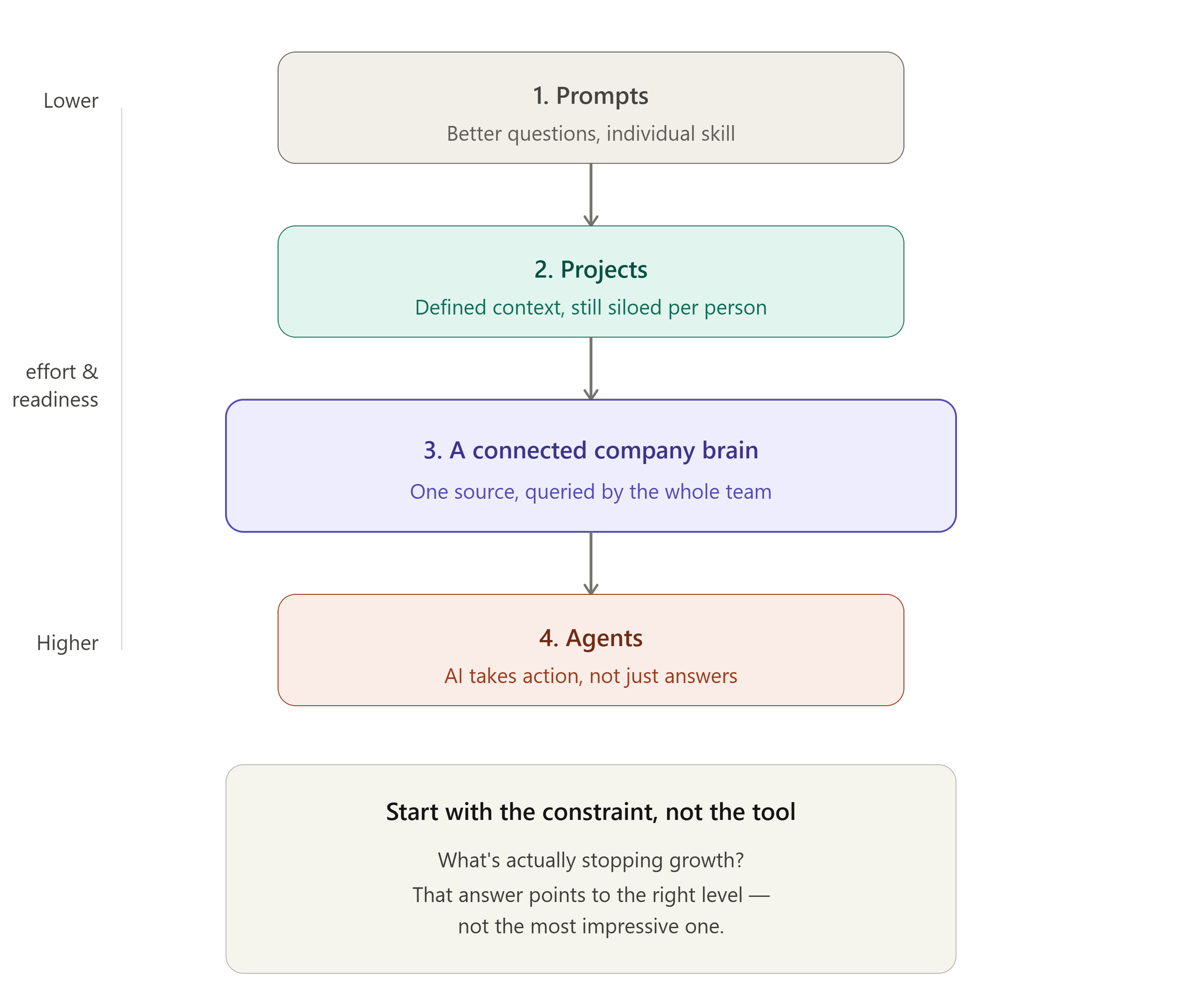
A Simple AI Framework for Business Owners norman@bocaedge.com
The Four Levels
Think of these as four distinct ways of using AI in a business, each one going a step deeper than the last. Most businesses don't need to reach the fourth level. Many shouldn't, at least not yet.
1. Personal Productvity - Prompts
This is the most accessible starting point, and the one almost every business has already dabbled in, whether formally or not. It means your team learning to write better prompts - clearer instructions, better context, smarter follow-up questions - when they use tools like ChatGPT or Claude.
What it gets you: Faster first drafts, quicker research, a genuine productivity bump for individuals who put the time in.
The ceiling: It's entirely dependent on the individual. Two people on the same team, doing the same job, will get wildly different value out of AI depending on how well they've learned to use it - and none of what either of them learns is captured anywhere the rest of the team can benefit from.
Who this suits: Almost everyone, as a baseline. If your team hasn't had even basic guidance on prompting, that's a free, fast win before you spend money on anything else.
2. AI that knows your business - Projects
The next step up is giving an AI tool a defined body of context to work from - a folder of documents, a specific process, a set of templates - usually through a "Project" feature in tools like Claude or ChatGPT. The AI's answers within that project are now grounded in something specific to you, rather than general knowledge.
What it gets you: Noticeably better, more relevant answers for a specific recurring task - drafting client proposals in your voice, answering questions about a particular process, working from a defined knowledge set.
The ceiling: It's still manual and still siloed. Someone has to build and maintain that project. It usually lives with one person or one small team. If five people each set up their own version, you're back to five different versions of the truth - just slightly better-informed ones.
Who this suits: Teams or individuals with a specific, repeatable task that would benefit from consistent context -without yet needing that context shared business-wide.
3. A Connected Company Brain - One source, queried by everyone
This is where the shift from individual productivity to organisational capability actually happens. Instead of one person's project with one folder of documents, this is your business's actual knowledge - documents, processes, templates, and (at a deeper level) live data from your CRM or operational systems - organised into a single layer that any team member can query through the AI tools they already use.
The team doesn't switch tools. They keep using Claude or ChatGPT exactly as before. What changes is what those tools can see.
What it gets you: Consistency. Everyone gets the same answer to the same question. New hires get productive faster because the business's accumulated knowledge isn't locked in someone's head. Answers come with a source you can actually verify, rather than a confident guess.
The ceiling: This requires a little more upfront thought - what knowledge matters and how it's organised. It's not a five-minute setup. But it's also not the IT overhaul people sometimes assume; done well, it connects to what you already have rather than replacing any of it.
Who this suits: Businesses where the real advantage lives in what the team collectively knows - relationship-driven sectors especially: recruitment, professional services, sales-led organisations. If inconsistent answers, knowledge walking out the door with departing staff, or slow onboarding are real costs to you, this is the level that addresses them directly.
4. Agents - AI doing the work, not just answering about it
The furthest step is AI systems that take action on your behalf - running a search, drafting and sending a follow-up, monitoring something continuously - rather than simply answering questions when asked.
What it gets you: Genuine time given back, on well-defined, repeatable tasks.
The ceiling: This is the level that most punishes a rushed approach. Agents acting on bad or inconsistent information cause real problems, not just unhelpful answers. They also tend to assume a foundation - a connected, reliable knowledge base - already exists underneath them. Without that foundation, an agent is automating chaos faster.
Who this suits: Businesses that have already got real value from level 3, with specific, well-understood, repeatable tasks worth automating. This is rarely the right starting point, however appealing it sounds.
---
Why Most Businesses Skip Straight to Four
There's a pull toward level 4 that's worth naming honestly: it's the one that sounds most impressive. "We've deployed AI agents" is a more exciting sentence than "we improved how our team writes prompts." But impressive and effective aren't the same thing, and the gap between them is exactly where the FOMO-driven decisions tend to go wrong.
The businesses I see get genuine, lasting value from AI are the ones that worked out which level actually matched their constraint - the specific thing slowing them down - rather than the one that matched the hype cycle. Sometimes that's level 1, and that's a perfectly good answer. Sometimes a business genuinely is ready for level 3 or beyond. The point of this framework isn't to push everyone toward the deepest end; it's to make the decision a deliberate one instead of a reactive one.
A Question Worth Asking First
Before any of the above, it's worth asking one thing: what part of your business is actually stopping you from growing the way you want to? Not "where could AI theoretically help" - every business can generate a long list of those - but what's the real bottleneck right now?
Once you know that, the question of which level of AI is appropriate tends to answer itself. The tools are secondary. The constraint is primary.
If you want help working through where your business actually sits or should sit on this, happy to talk it through. Reach out to organise a coffee today.