
What a good team meeting looks like
The Pleasant A-HA moment!
Last week, I sat in on a client's team meeting and had this realisation: "This is a well-run business!"
They have doubled the numbers on their key business development metric in the first 3 weeks of 2026 compared to last year.
Not that everything was smooth or perfect. But there was something different in the room - clarity and purpose. Everyone knew their numbers, could see each other's numbers, and were sharing what actually worked. Team members weren't just reporting activity; they were teaching each other.
The conversation had shifted from "what should I be doing?" to "here's how I hit my targets this week."
It struck me because I remembered what this same room felt like a year ago.
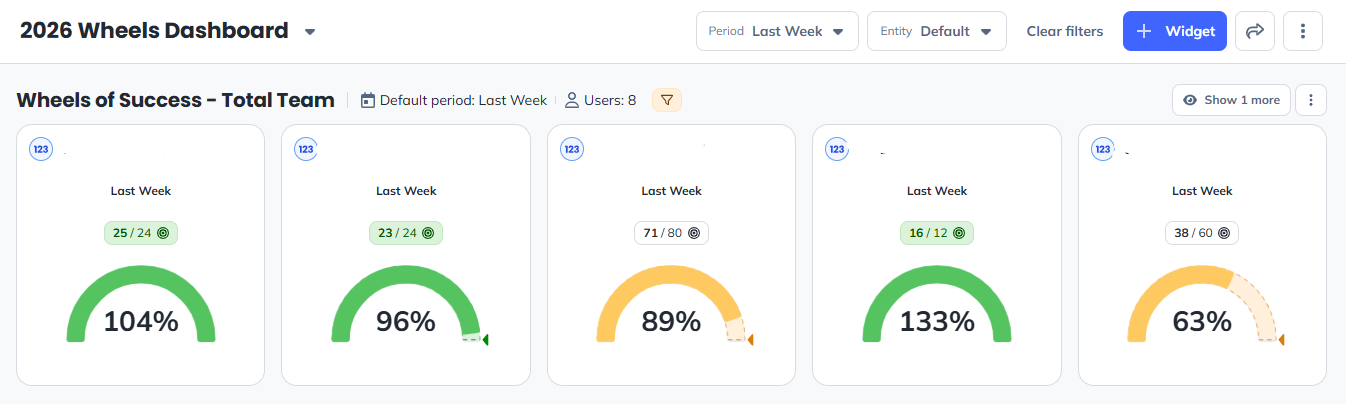
Client 2026 Dashboard that helps drive the right behaviours and success!
What Changed in a Year
A year ago, this same team was in a different place.
Meetings covered the same topics week after week. The manager emphasized key metrics - everyone understood what mattered. But team members gave activity updates based on their own tracking, which was inconsistent. Things weren't sticking the way they needed to.
The catalyst for change came from an unexpected place: their CRM system wasn't working. They weren't getting the data they needed, and the features they wanted were expensive add-ons.
But as we dug into it, the real issue wasn't just the tool. It was that they had no clear way to see whether anyone was actually doing what the manager kept emphasizing. Good intentions, but no shared visibility.
The Three Core Changes
With those foundations in place, here's what actually changed:
1. We Crystallized the Metrics
The owner already had strong instincts about what drove success. My job wasn't to tell him what mattered - it was to help him turn those instincts into measurable weekly behaviors.
We worked together to define what they now call their "Wheels of Success" - the weekly activities that, if done consistently, would drive the business forward. Not vanity metrics. Not lagging indicators. Leading behaviors with a proven correlation to revenue.
For a recruitment business, this meant tracking specific activities: meetings, pitches etc…
The breakthrough was specificity. Not "do more business development" but "have X client meetings and Y candidate meetings per week."
2. We Made Everyone's Numbers Visible
We implemented a new CRM system and a dashboard tool that brought the data to life. Every week, everyone could see everyone's numbers. Real-time. No hiding.
This is uncomfortable at first. But transparency changes behavior in ways that private tracking never can. When your numbers are visible to your peers, you're accountable not just to your manager but to your team.
3. We Let Data Validate What the Owner Already Knew
After a few months of tracking, patterns emerged from their own data. The behaviors the owner had emphasized for years? The data proved they mattered.
But now it wasn't just "the boss says this matters." It was "our own numbers prove this matters."
That shift - from leadership mandate to data-driven truth - transformed how the team received the message. It became their playbook, not just his instructions.
The Playbook: What Really Made the Difference
Here's what I've come to understand: visibility alone isn't enough.
You can give a team dashboards that show them exactly where they stand. But if they don't know what "good" looks like, or how to get there, the dashboard is just a scoreboard for a game they don't know how to play.
The playbook is the difference.
A playbook is straightforward: it defines the weekly behaviors that, if done consistently, will drive success. But it's not just "hit these numbers." It's understanding why these behaviors matter and what happens when you consistently execute them.
This is what transforms a dashboard from measurement tool to performance system. The team knows what success looks like, can see who's achieving it, and can learn from each other about how to get there.
Each month, they can see which behaviors actually drive results. What patterns emerge from top performers. It's not generic advice from an industry report - it's "here's what works here, based on our data."
So meetings aren't just about visibility. They're about clarity and improvement.
Result: They've doubled their client meetings per person since this time last year.
But more importantly, the conversation in the room has changed. From "you should" to "here's how I did."
What You Can Take Away
If you're reading this and thinking your team meetings could benefit from more clarity and focus, here's what I'd suggest:
Start with Clarity on What Actually Drives Success
Most leaders already know what matters in their business. The problem isn't knowledge - it's articulation and measurement.
Ask yourself: If I could only track 5-7 weekly behaviors, what would they be? What activities, if done consistently, would guarantee success over time?
Don't guess. Look at your own top performers. What do they do that others don't? That's your starting point for the playbook.
Make the Invisible Visible
Once you know what matters, make it visible. This requires the right tools - a CRM or tracking system that captures activity, and a dashboard that makes the data easy to see.
But more importantly, it requires commitment to actually looking at the data together. Weekly. As a team. With everyone's numbers visible.
Build Your Own Playbook
Don't import best practices from another industry or copy what successful companies do. Build a playbook from your own data.
Track your key behaviors for a few months. Let patterns emerge. See what actually correlates with success in your business, with your team, in your market.
Then codify it. Make it simple enough to follow. Clear enough that everyone knows what "good" looks like.
Three Things That Need to Be in Place
Through this project and others, I've learned that three foundations are critical:
Owner commitment - The leader must demonstrate commitment by making the system central to how the business runs. Systems don't change behavior - leaders using systems in front of their teams change behavior.
Strong guidance - Teams need confidence in the system from day one. If there are doubts about the data, team members will hide behind "the system doesn't work" rather than engaging in improvement. Clear documentation, one-on-one support, and quick resolution of any issues build that confidence.
A team champion - You need someone on the ground handling day-to-day implementation, data management, and ongoing support. The owner can't do this alone while running the business. This was a gap in our project initially, and progress accelerated when they brought someone on internally to focus on it.
Without all three, the system might get implemented, but it won't be used effectively.
The Bigger Lesson
Most teams don't have a knowledge problem. They have an operationalization problem.
The leader knows what drives success. The team is willing to do the work. But there's no bridge between what the leader knows and what the team does consistently.
That bridge is built from clarity (what does good look like?), visibility (are we actually doing it?), and learning (what's working for others that I can apply?).
When you have all three, the conversation shifts from "what should we do?" to "how can we do it better?"
Looking Forward
Watching that meeting last week, I saw what's possible when you take the time to understand what drives success in a business, capture the right data, and create a system that helps the team learn from each other.
It took about a year from "our CRM isn't working" to "this is running well." With focused commitment, it could happen faster.
Your instincts about what matters are probably right. Your team is probably capable. What's often missing is the system that connects what you know to what they do, and lets them learn from each other along the way.
If you're struggling to operationalize what you know works, or you'd like to explore how better systems could help your team run more effectively, I'd be happy to have a conversation.
Reach out at norman@bocaedge.com or connect with me on LinkedIn.
Note: Systems used to generate data were RecruitCRM and OneUp.